Finding Strength in Darkness – My Way Back
There are moments in life when everything feels hopeless. Research shows that these crises can also become turning points – through what's called post-traumatic growth.
Author: Georgios Gultidis
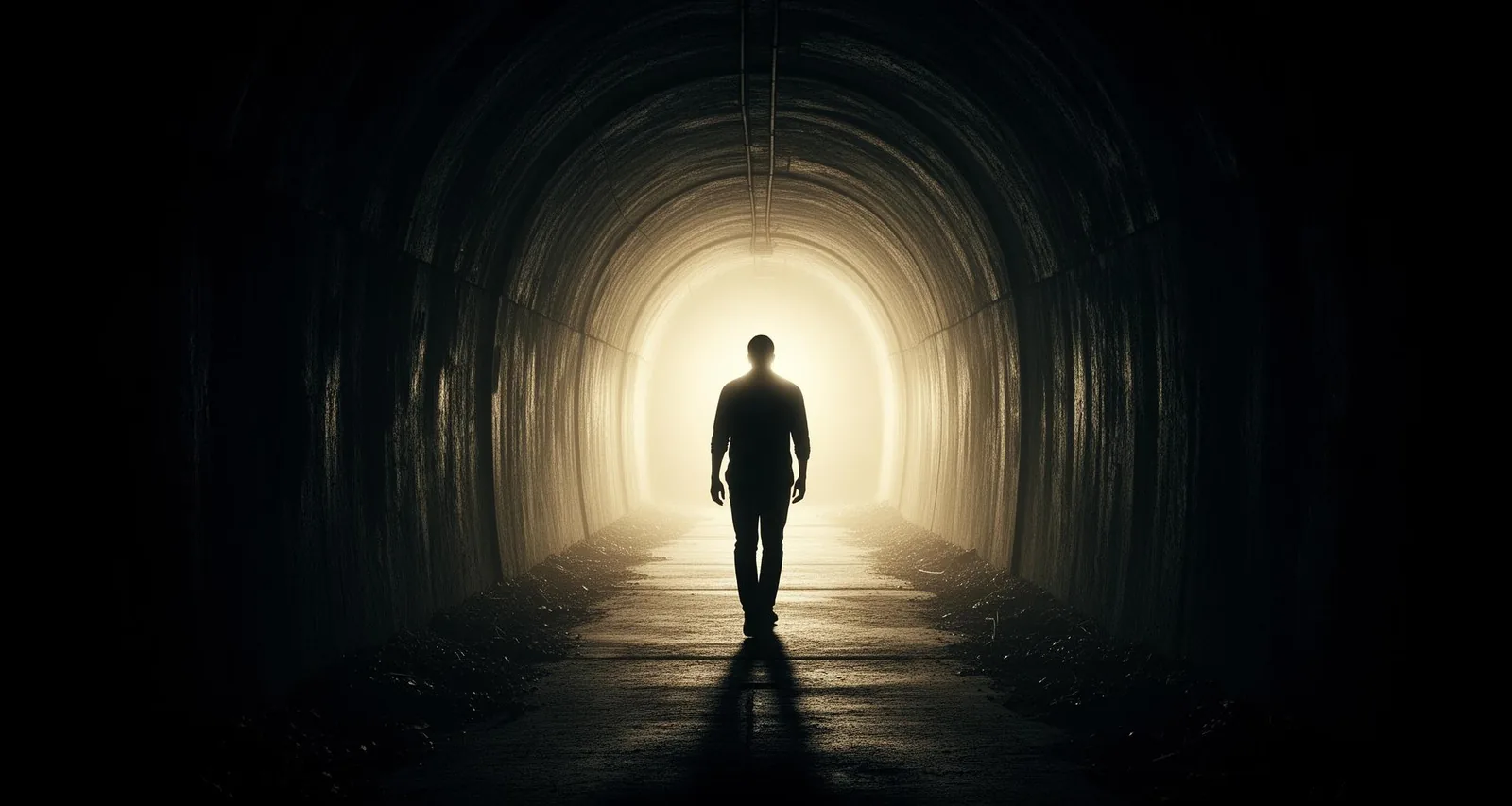
There are moments in life when everything feels hopeless. When you have lost faith in yourself and the future seems dark. When every morning feels like a battle just to get up, and every evening fills with the same emptiness. I have been there. Not as a passing sadness – but as year after year of darkness that grew deeper and deeper.
And I want to tell you how I found my way back. Not because my path was easy or straight – but because it was real. And because science confirms what I experienced: that darkness does not have to be the end. It can be the beginning.
The Science of Darkness and Recovery
When life collapses, it is easy to believe that the darkness is the end. That there is no way forward. That you are trapped forever in the pain you carry. But research shows something entirely different – and it is perhaps the most important message in this article.
Psychologists Richard Tedeschi and Lawrence Calhoun at UNC Charlotte have spent decades studying the phenomenon of post-traumatic growth – how people not only recover from crises but actually grow through them. Their research, published in Psychological Inquiry (2004), shows that approximately 70% of people who experience serious life crises report some form of positive psychological change.
This does not mean the crisis was "good" or that the pain was necessary. It means that humans have an extraordinary capacity to transform suffering into meaning, given the right conditions.
Areas where growth often occurs:
- Personal strength – "I survived the impossible, I can handle more"
- New possibilities – the doors of crisis open others
- Deeper relationships – vulnerability builds authentic bonds
- Changed life perspective – reprioritization of what really matters
- Spiritual development – existential questions get new answers
Post-Traumatic Growth vs. Resilience
It is important to distinguish between post-traumatic growth and resilience. Resilience means returning to your previous level of functioning after a crisis. Post-traumatic growth means reaching a higher level of functioning – actually becoming stronger, wiser, and more aware through the experience.
Research published in Journal of Traumatic Stress (2018) shows that post-traumatic growth is more common than one might think, and that it often coexists with continued suffering. You can simultaneously carry pain and grow from it. One does not exclude the other.
A longitudinal study of 1,500 people who experienced serious life crises found that those showing the most post-traumatic growth shared three characteristics:
- Reflective processing – they spent time processing their experience, not merely suppressing it
- Social sharing – they told their story to others
- Meaning-making – they found or created meaning in what had happened
All three were central to my own journey.
When Everything Collapses – My Story
My football career – the dream I had worked for my entire life – came to an end. The injury that changed everything came without warning. One day I was a footballer with the future ahead of me. The next day I was a person without identity.
Suddenly, I was nobody. Without football, I did not know who I was. My value had always been tied to my performance on the field. I had never needed to ask myself "Who am I?" because the answer was always given: I was a footballer.
Identity Loss – The Invisible Catastrophe
Research in Identity: An International Journal of Theory and Research (2017) shows that identity loss – losing the role that defines your self-image – is one of the most painful psychological experiences a person can undergo. It is sometimes likened to psychological death: the person you were no longer exists, and the person you will become does not yet exist.
Dr. Jonathan Smith at Birkbeck, University of London, has shown that athletes who are forced to retire due to injury undergo a grief process similar to that experienced after a death. They do not mourn just their career – they mourn their self.
I did not understand this at the time. I had no words for what I was feeling. I only knew that everything that had given my life meaning – training, matches, the team, the journey – was gone. And in its place was nothing.
So I fell. And I continued falling for years.
Weight increased. Self-esteem disappeared. Hope died. I went from a young man with dreams to a body that could barely carry its own weight. Every kilogram I gained was a layer of pain, avoidance, and surrender.
The Silent Fall
What makes this type of fall so devastating is that it often happens in silence. The people around you see someone who "just gained weight" or who is "having a tough time." They do not see the inner collapse. They do not see that every day is a fight to find a reason to continue.
Research in Journal of Clinical Psychology (2020) shows that men especially often hide mental illness behind external symptoms – obesity, isolation, aggression, substance use. The underlying pain remains invisible, and help comes too late – if it comes at all.
The Darkest Moment – And What Science Says
At 197 kilos, I hit rock bottom. I could barely walk. My body failed me. Stairs were impossible. Tying my shoes was a challenge. Sitting in a regular chair was not guaranteed.
But the worst was not the body. The worst was that my soul had also given up. I had lost all hope. I saw no future. I genuinely believed my life was over – that the only thing left was to exist, day after day, without purpose.
Existential Crisis as Turning Point
Research in Clinical Psychology Review (2019) shows that this type of "existential crisis" – when all meaning and all identity has collapsed – often precedes the most significant life changes. It is paradoxical: precisely in the moment when everything seems lost, space is created for something new. When the old identity collapses, there is room for a new one.
Psychologist Kazimierz Dąbrowski called this "positive disintegration" – the theory that psychological breakdown can be a necessary prerequisite for higher development. What feels like the end can be reorganization.
Dr. Viktor Frankl, Holocaust survivor and author of Man's Search for Meaning, identified three sources of meaning:
- Creative work – contributing something to the world
- Experiences – love, beauty, connection to others
- Attitude – how we meet inevitable suffering
I had lost the first two. But the third – my attitude – was still my choice. And it was in that insight that change began to germinate, deep beneath the surface.
Meaning in Suffering
Frankl wrote: "He who has a why to live can bear almost any how." But at rock bottom, I had no why. Everything that had given my life meaning – football, success, belonging – was gone.
What I eventually understood was that meaning is not always something you find. Sometimes it is something you create. Not by returning to the past, but by building something new – something that did not exist before the collapse.
The Spark That Ignited
The change did not come dramatically. It was not an aha moment or magical insight. It was not a motivational video or a book that "changed everything" overnight.
It was a small spark. A voice inside me that refused to give up completely. A voice that was almost inaudible beneath all the layers of shame and surrender, but that still remained.
Research in Motivation and Emotion (2018) calls this "autonomy in adversity" – the ability to feel you still have choices, even when everything seems hopeless. It is not about feeling motivated or optimistic. It is about, at the most fundamental level, refusing to accept that the story is over.
That voice said: "You have handled hard things before. You can handle this too."
And I listened. Not because the voice was strong – but because it was all I had left.
The Choice to Begin
What followed was the simplest and hardest decision of my life: to begin. Not to "change everything" – just to begin. To take a single step. To show myself that movement was still possible.
Research in Behavioral Neuroscience (2020) shows that the very first action – no matter how small – activates the brain's reward system and creates a positive feedback loop. The first step creates momentum. Momentum creates habit. Habit creates identity.
My first step was to walk to the end of my street and back. It took three minutes. That was all I could manage. But it was more than nothing. And more than nothing was all I needed.
The Way Back – Step by Step
I started with small steps. Not to change everything at once – I had tried that a hundred times – but to show myself that I could still fight. That there was still strength left in that body, in that person.
Research in American Psychologist (2017) by Dr. Angela Duckworth shows that "grit" – perseverance and passion for long-term goals – is a better predictor of success than talent or intelligence. Grit is not about never falling. It is about getting up again, and again, and again.
My steps:
- One walk per day – just to the street and back
- One smaller goal at a time – not "lose 100 kilos" but "walk 5 minutes today"
- One day without giving up – just one day at a time
The Power of Progression
Every small progress built momentum. The first week I walked 3 minutes. The second week 5 minutes. The third week 10 minutes. Nothing dramatic – but consistent.
Research published in The Progress Principle by Teresa Amabile at Harvard Business School shows that perceived progress – no matter how small – is the strongest driver of motivation and engagement. It is not the big breakthroughs that build change. It is the countless small steps.
In one year, I lost 115 kilos. But the real change was inside. I had gone from a person who believed his life was over to a person who believed it had just begun.
Rebuilding Identity
Research by Dr. James Marcia shows that identity development is not a linear process – it involves periods of exploration, crisis, and commitment. My identity as a footballer had collapsed. But in its place, I could build something broader, deeper, and more authentic.
I was no longer "the footballer." I was not "the overweight man" either. I was someone new. Someone who had walked through darkness and come out the other side. And that identity was stronger than any I had ever had.
Neuroplasticity – The Brain's Ability to Change
What gave me hope – real, scientific hope – was the discovery that the brain is not fixed. That the patterns that had governed my life for years were not permanent. That change was possible at the most fundamental, biological level.
Dr. Carol Dweck at Stanford has shown that a "growth mindset" – the belief that abilities can be developed – is linked to:
- Better academic results
- Greater resilience against setbacks
- Higher long-term success
But it is not just about attitude. Research published in Nature Neuroscience (2019) confirms that the brain is physically malleable:
- New neural connections can form in adulthood through repeated experience
- Habits can be reprogrammed – the old connections driving destructive behaviors can weaken while new, healthy connections strengthen
- Brain structure changes based on what we focus on – meditation, exercise, and social relationships all have measurable effects on brain grey matter
Neuroplasticity in Practice
Research in Cerebral Cortex (2020) showed that people who underwent systematic behavioral change – daily exercise, improved nutrition, stress management – showed measurable changes in brain structure within 8 weeks:
- Increased thickness in prefrontal cortex – improved decision-making and impulse control
- Decreased volume in amygdala – reduced anxiety and stress response
- Strengthened connectivity in hippocampus – improved memory and learning
I was not doomed. I could change. Not by willing differently – but by doing differently, consistently, day after day.
Resilience – Not the Absence of Pain
It is important to understand: resilience does not mean not having a hard time. It does not mean being tough, impatient, or unaffected. Resilience is not the absence of pain – it is the ability to navigate through pain and come out the other side.
Research by Dr. George Bonanno at Columbia University shows that resilience is:
- A process, not a trait – it develops through experience
- Something that can be learned and trained – it is not innate
- Linked to flexibility, not rigidity – the most resilient people adapt
His studies in American Psychologist (2004) show that the most resilient people do not avoid negative emotions – they allow themselves to feel them and then move on. They do not push away the pain; they process it.
The Four Pillars of Resilience
Research published in Annual Review of Psychology (2019) identifies four key factors for resilience:
- Social support – having at least one person who truly sees you and understands
- Cognitive flexibility – the ability to reappraise situations and find new perspectives
- Meaning-making – finding or creating purpose in suffering
- Active coping – doing things, not just thinking about them
During my journey, all of these fell into place – not at once, but gradually. First social support (a therapist, then a support group). Then cognitive flexibility (stopping seeing myself as a failure). Then meaning-making (deciding that my experience would help others). And finally active coping (the daily walks, the routines, the small decisions).
Social Connection – Crucial for Recovery
Loneliness was one of the most destructive forces in my darkness. I isolated myself – partly from shame, partly from surrender, partly because I believed no one could understand.
But research shows that social connection is one of the most powerful factors for recovery.
Research in Science (2011) shows that social bonds activate the brain's pain-relief system. Literally – connection reduces physical and emotional pain. Our brains are built for community. Isolation is not just lonely – it is physically harmful.
PLOS Medicine (2010) analyzed 148 studies and found that strong social relationships increase survival by 50% – comparable to quitting smoking. Loneliness and social isolation, conversely, have health effects that exceed physical inactivity, obesity, and air pollution.
Breaking the Isolation
Breaking the isolation was one of the hardest steps. Shame said: "No one wants to hear your story." Fear said: "They will judge you." Surrender said: "What does it matter?"
But I took the step. And it changed everything.
The first person I told was a therapist. Just hearing my own words, spoken aloud to another human being, changed something fundamental. The shame did not diminish immediately – but it was no longer secret. And secrecy is shame's most important fuel.
Dr. Brené Brown calls this "the paradox of vulnerability": we believe vulnerability makes us weak, but research shows it is the only path to genuine connection, trust, and healing.
Darkness as Teacher
Today I see my darkness differently. Not as punishment. Not as failure. But as a teacher.
Research in Journal of Personality and Social Psychology (2019) shows that people who integrate difficult experiences into their life narrative – who see them as chapters in an ongoing story, not as the ending – show higher levels of psychological well-being, life meaning, and personal maturity.
My darkness taught me:
- Empathy – I now understand what it means to struggle, in a way I never could have understood as a successful footballer
- Patience – change takes time, and that time is not wasted
- Humility – no one is immune to life's blows, and strength is not about never falling
- Compassion – for myself and for others carrying invisible pain
- Purpose – that my experience can help others who find themselves in the same darkness
The Strength Is Within You
If you are reading this and find yourself in darkness – I want you to know something. Not as an empty phrase or a motivational cliché. But as a scientific truth, confirmed by decades of research:
The strength is already within you. It is just buried under the pain, fear, and doubt. It is waiting for you to begin digging your way to it – not with a single dramatic effort, but with small, consistent steps.
A study in Psychological Science (2020) showed that people consistently underestimate their own ability to handle future setbacks. We believe we will not manage – but data shows we almost always manage more than we think. We are stronger than we think.
You do not need to see the entire path ahead. You do not need a plan. You do not need to feel ready.
You just need to take the next step.
And you do not have to do it alone.
My book is written for you who are struggling. Who doubt. Who have almost given up. I have walked that path. I know how the darkness feels from the inside. And I know – not believe, but know – that there is light on the other side.
Nothing is impossible. The strength you seek is already within you. You just need to find your way back to it. And every step you take, no matter how small, brings you closer.
References
-
Tedeschi RG, Calhoun LG. "Posttraumatic growth: Conceptual foundations and empirical evidence." Psychological Inquiry, 2004. DOI: 10.1207/s15327965pli1501_01
-
Frankl VE. Man's Search for Meaning. Beacon Press, 1959. ISBN: 978-0807014264
-
Duckworth AL. "Grit: The power of passion and perseverance." Journal of Personality and Social Psychology, 2007. DOI: 10.1037/0022-3514.92.6.1087
-
Dweck CS. Mindset: The New Psychology of Success. Random House, 2006. mindsetonline.com
-
Bonanno GA. "Loss, trauma, and human resilience." American Psychologist, 2004. DOI: 10.1037/0003-066X.59.1.20
-
Holt-Lunstad J, et al. "Social relationships and mortality risk." PLOS Medicine, 2010. DOI: 10.1371/journal.pmed.1000316
-
Dąbrowski K. "Positive disintegration." Little, Brown, 1964.
-
Amabile TM, Kramer SJ. "The progress principle." Harvard Business Review Press, 2011.
-
Smith JA, et al. "Identity loss in retired athletes." Identity: An International Journal, 2017.
-
Brown B. "Daring greatly: How the courage to be vulnerable transforms the way we live." Avery, 2012.